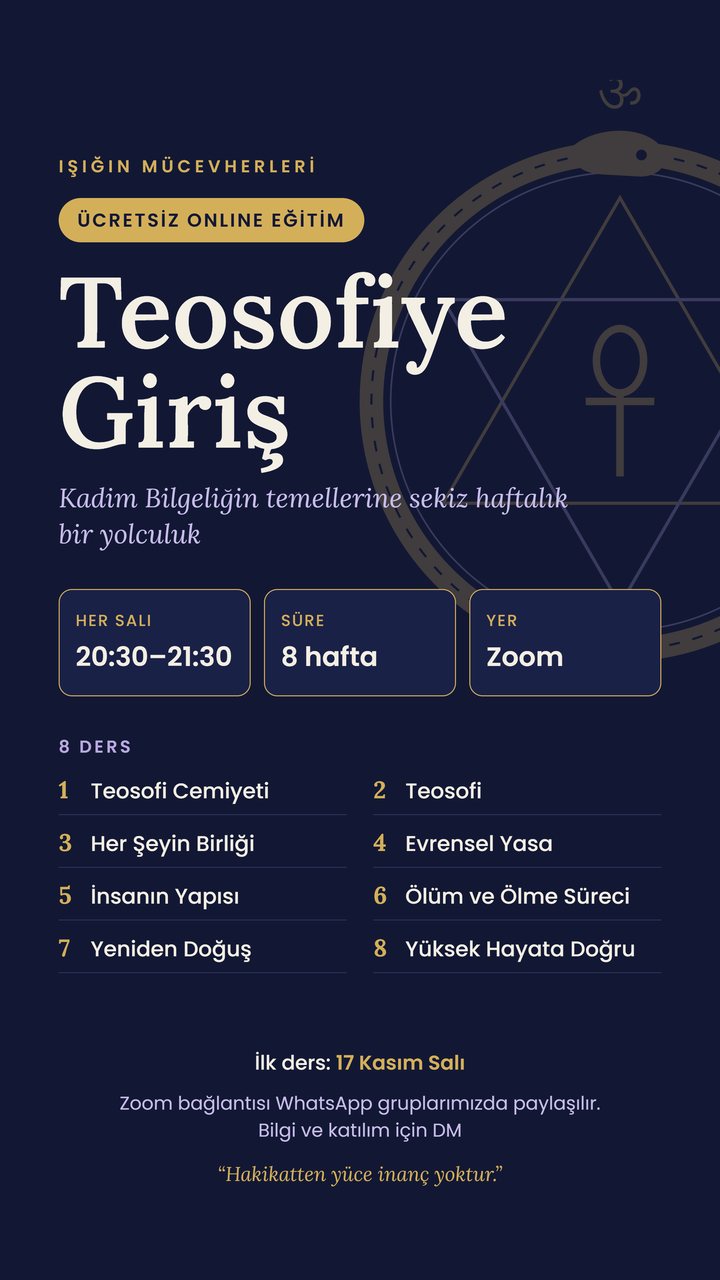
Free online course

Introduction to Theosophy

An eight-week journey into the foundations of the Ancient Wisdom. We study the core teachings of Theosophy together every Tuesday evening.

Introduction to Theosophy course poster
Courses

Free Introduction to Theosophy Course

  • WhenEvery Tuesday, 20:30–21:30
  • Length8 weeks, 8 lessons
  • First lessonTuesday, 17 November
  • FeeFree · Zoom

Who Is It For?

For anyone curious about what Theosophy is and who wants to get to know the Ageless Wisdom within a clear, orderly framework. No prior knowledge is needed. It is also a good start for those looking for solid ground before reading Blavatsky, The Secret Doctrine or Alice A. Bailey.

How Does It Work?

Classes are held every Tuesday at 20:30 (Istanbul time) on Zoom and last one hour. When you write to us on WhatsApp, we add you to the course group, where the Zoom link and class notes are shared. Each class opens with a short review of the previous one, moves through three parts and closes with questions for reflection. A small reading and practice suggestion is given for each week.

Teacher

The course is taught by Ayşen Mısra Karaloğlu of the Jewels of Light community.

The Flow of a Class · 60 minutes

  • 0–5 min · OpeningReview of the previous class and the week's experiences.
  • 5–50 min · Three partsThe three main headings of the topic, with quotations from the sources, tables and examples.
  • 50–60 min · ClosingReflection, questions and the weekly study.
  • During the weekSmall practices such as reading suggestions, seed thoughts and the evening review.
8 weeks · 8 classes

An Eight-Class Journey

From the birth of the Society to the Higher Life: each class builds on the one before and unfolds, step by step, the three fundamental principles of Theosophy: the One, the Law and man.

1

The Theosophical Society

Origins, founders, objects and the birth of a community of seekers

“We are seekers, not teachers.” H. S. Olcott, 17 November 1875

In the 19th century, as materialism rose and religion closed itself to questioning, a society was born in New York in 1875. Founded by Blavatsky, Olcott and Judge, it was not a community of belief but a community of inquirers who reject nothing without reason and accept nothing without evidence.

  • The 19th-century setting and the founding
  • Three founders: Blavatsky, Olcott, Judge
  • The Society's three objects and motto
  • The spread of the movement and its later branches

Question for reflectionWhich of the three objects is closest to me, and which is the farthest?

2

Theosophy

Divine Wisdom: the ancient teaching underlying all religions and philosophies

“Theosophy was not invented; it was discovered.”

Theos and sophia: "knowledge of divine things". We get to know the three fundamental principles of this teaching, known by names such as the Wisdom-Religion, the Secret Doctrine and Gupta Vidya, and Blavatsky's two great works, Isis Unveiled and The Secret Doctrine.

  • The root of the word and its definitions
  • Different names of the same teaching
  • Three fundamental principles and the three propositions of The Secret Doctrine
  • The fivefold aim of The Secret Doctrine

Question for reflectionWhat does the phrase "a scientific religion and a religious science" bring to mind for me?

3

The Unity of All Things

The One Life: the firm foundation of all theosophical philosophy

“Other than it there nothing beyond existed.” Rig Veda

The senses speak of multiplicity; esoteric philosophy speaks of unity. We study the teaching of unity that echoes in every tradition, from Taoism to Christian mysticism, and the five consequences of this one reality, and together we practise absorbing what we read through reflection.

  • The One Life and the teaching of unity across traditions
  • The five consequences of unity
  • Tat tvam asi: That thou art
  • Reflective reading practice in class

Question for reflectionWhat does the sentence "Forms pass, Life remains" mean to me today?

4

The Universal Law

Karma: the Law at work in all the activities of the universe

“We reap what we sow; but we can choose the seed.”

Karma is not punishment or bad luck; it is the way the universe works. We discuss the seven aspects of the One Law, the difference between the law of nature and human law, and karma not as fate but as a creative opportunity.

  • Karma: the word and its definition
  • The seven aspects of the Law
  • Periodicity and the septenary law
  • The three kinds of karma and the creative opportunity

Question for reflectionWhat opportunity does a situation I call "fate" in my life offer me?

5

The Constitution of Man

A god in animal form: the seven principles of man

“Know ye not that ye are the temple of God?” 1 Corinthians 3:16

We get to know the seven principles of man from Atma to the physical body, the immortal Higher Triad and the transient Lower Quaternary. From Paul's threefold man to the chariot image of the Katha Upanishad, we set six different maps for reading man side by side.

  • Seven principles: Atma, Buddhi, Manas and the Lower Quaternary
  • The dual mind: higher and lower Manas
  • Spirit, soul and body
  • The mirror, the chariot and the five sheaths

Question for reflectionWhat do I identify with most during the day?

6

Death and the Process of Dying

Not an event, but a process

“Forms pass, Life remains.”

Knowing the constitution of man is the precondition for understanding death. We follow the eight stages from the review of life to Kama Loka, from the second death to Devachan and the return, and look at what the teaching says at the bedside of the dying, in grief and as we prepare for our own death.

  • What dies, what remains?
  • The eight stages of death
  • Kama Loka and Devachan
  • A practical view for the living

Question for reflectionWhat from this life will enter the "harvest"?

7

Rebirth

Reincarnation: a pilgrimage for which a single life is not enough

“The dweller in the body casts off worn-out bodies and enters into others that are new.” Bhagavad Gita 2:22

Successive lives are like pearls strung on a thread: the thread is the living Principle, the pearls are separate lives. We take up who is reborn and why, why karma and reincarnation are twin teachings, and their place in the traditions and in research.

  • The actor and the roles: who is reborn?
  • The twin teaching inseparable from karma
  • The traditions and Ian Stevenson's research
  • Why don't we remember?

Question for reflectionWhich of my abilities seems "brought along" rather than acquired in this life?

8

Towards the Higher Life

The Path, discipline and the first step: the teaching becoming life

“Lead me from darkness to Light.” Brihadaranyaka Upanishad

In the last class the whole teaching turns into practice: the names of the Path, Blavatsky's Golden Stairs, the ethical foundation and three areas of effort drawn from Patanjali's eight limbs. With guides such as The Voice of the Silence and Light on the Path, a definite beginning: now.

  • The Golden Stairs
  • Ethics first: the first rules of the Path
  • Three areas of effort and the four qualifications of the Path
  • Guidebooks and the first step

Question for reflectionWhat is the single, concrete beginning I set for myself for the coming month?

Frequently asked

Frequently Asked Questions

Do I need prior knowledge?

No. The course starts from scratch and explains the basic ideas step by step.

Is there a fee?

No, the course is entirely free.

How do I sign up?

Just message us on WhatsApp saying you would like to join the Introduction to Theosophy course. We will add you to the course group, where the Zoom link is shared.

Are "teosofi" and "teozofi" the same?

Yes. They are two Turkish spellings of the same word, from the Greek theos (god) and sophia (wisdom): "divine wisdom". See our article What Is Theosophy? for more.

Participation

Free · Online · 8 weeks · Every Tuesday 20:30–21:30 · First lesson 17 November

Message us on WhatsApp to reserve your place and we will add you to the course group.

Join on WhatsApp