O Brahman, this world and everything in the universe rests fundamentally on the mind; at no time can it exist apart from the mind. Almost all the people of this world walk in a universe of dreams, fancies and egoism, take it to be real and delight in it. The universe rests in Chitta1 alone. As in the simile of "the crow and the palm fruit" (the fruit falling at the very moment the crow alights; an apparent causation arising by chance), the effects or manifestations of the mind are truly astonishing. Thus people see the one dream of the universe in various forms. In a single play, many children of men assign themselves different roles.
— Laghu-Yoga-Vasishtha, V, 5
Maya or illusion is not, as in the common use of the word, a fancy pointing to something that does not exist. The illusion around us and within us is "real" in the sense that it truly exists. Our maya or illusion arises from our not seeing things as they are, and often from our knowingly refusing to see them, so that we fall prey to the deceptive play of our own confused inner faculties. Every kind of extremism, for instance, however sincere, is caught in the web of its own misunderstandings.
This fact alone has an immense moral significance, for it teaches us to be tolerant of others and to acknowledge the weaknesses of our own understanding, our strong prejudices, and our tendency to look at events as though through a dirty, darkened glass. The scientist of a hundred years ago who held ideas about the physical universe that have since been proved false, and who was fanatical enough to think he had arrived at the truth, was under the influence both of the maya of his own age and of the illusion that with his imperfect vision he had solved the unknown.
The religious believer who embraces theological doctrines that today's wider knowledge has shown to be false or half-true lives under a similar maya. The materialist who says that man is nothing but a living mechanism is as much under the sway of illusion as the believer who thinks, in the words of the once highly revered Dr. Isaac Watts, that on the Day of Judgment "bones will fly about to every corner of the sky."
Perhaps, with intense mental and emotional conviction, we weave all manner of deceptive webs of thought and feeling and believe for a while that we are right. But later, when experience has taught us more, we realize that we have been slaves to the maya of our own false imaginings. Some scientific theories seriously defended today are as mayavic as anything that can be drawn from the pages of history. Yet these illusions, whether scientific, philosophical, theological or of any other kind, are relatively real to those who hold them for as long as they last.
The Doctrine of Maya
The doctrine of maya is taught in one form or another in almost all the great religious and philosophical schools of India, ancient and modern, and is especially prominent in Advaita Vedanta (the doctrine of non-duality). It is also a feature of Buddhism; today it is more prominent in the Northern schools of the Mahayana than in the Southern Buddhism of the Hinayana.2
The word maya derives from the verbal root ma, meaning "to measure, to set measure and limits," and hence it denotes limitation, transience, and everything that is impermanent. Here we find almost exactly the distinction often drawn in some European schools of philosophy between what is Real and what merely appears, that is, what presents a phenomenal appearance. It is an important step to pass from these general ideas to the understanding that everything phenomenal, and therefore transient, is illusory and has no lasting reality. From this thought, in turn, arose the idea common to the philosophical systems of India, Buddhism included: that everything illusory is in a strange sense magical, because it presents a false appearance that deceives both the senses and the mind.
Consider man himself. In his essence man is a divine-spiritual Monad (the immortal spiritual unit at the core of every being), which pervades all the phenomenal and therefore illusory worlds and the spheres of manifested existence. This divine-spiritual Monad is eternal, for it is a drop of the cosmic Logos, of the cosmic Spirit; for every being in our universe, it is what is Real. Yet all the parts of the human constitution in which the Monad clothes itself are, because of their more or less impermanent nature, illusions when compared with the divine Monad itself. It would be absurd to say that man has no real being and existence, for he most evidently exists. But only the Monads, which are drops of eternity, are Real; everything else is a "spell" cast in time and space by the coming together of karma to produce all the phenomenal aspects of the human constitution.
The maya of the lower levels of any being or thing, whether we speak of a galaxy or of a man, certainly exists. But whatever the case, it is clear that the manifold diversity around us is neither nonexistent in an absolute sense nor different and separate from the Reality behind it. If it were, we would have invented an inexplicable dualism between the underlying Real and the manifesting illusion, and there would be no way left to explain how the phenomenal flows from the noumenal, that is, from the Real. According to this mistaken theory the two would be wholly separate, and the phenomenal would have no root connection with the Real. Philosophically, therefore, maya, even Mahamaya (the great cosmic illusion), is a function of Reality, its veil; it is born from Reality itself and is destined in the end to be merged into it again.
The Dream of the Cosmic Mind
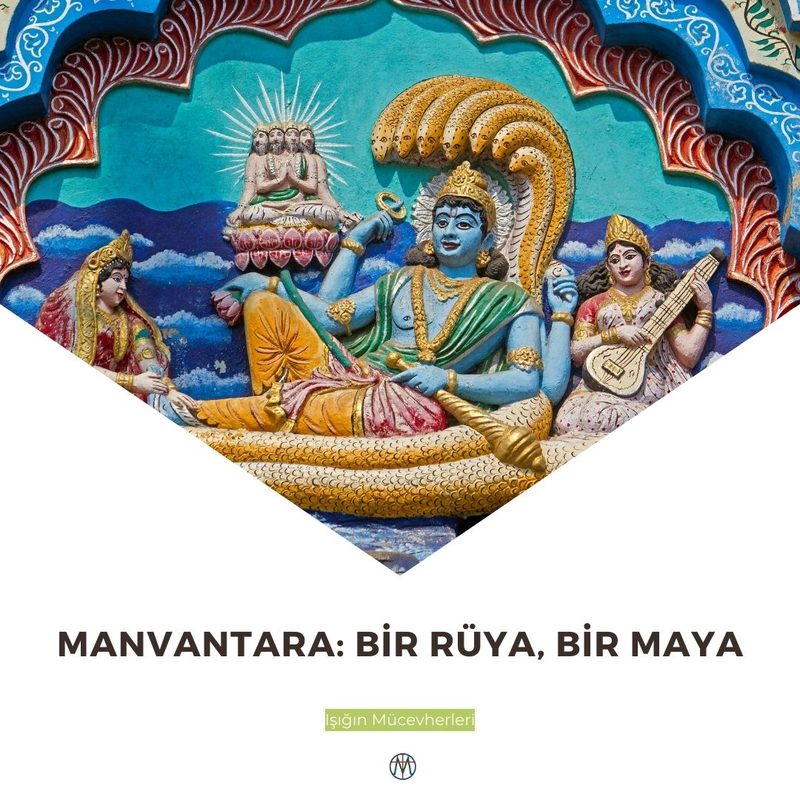
Let us now touch on an aspect of the doctrine of maya that is generally given little attention in the exoteric systems of philosophy. All the beings, worlds and planes that appear when the universal Manvantara (the period of cosmic manifestation and activity) begins may be regarded as having a profound reality as visions or dreams produced by and within the cosmic mind or cosmic Spirit.
In the case of man, the incarnation of the Spiritual ego is a relative "death" for that ego; likewise, the end of its manifestation in the worlds of matter is a reawakening of the Spiritual ego to a wider self-consciousness on its own planes and in its own worlds. If we follow the master key of analogy, what we call Manvantara is the death of the cosmic spirit. In a paradoxical sense it is a kind of Devachan (the dreamlike state of bliss between death and rebirth) of the cosmic spirit or mind, even a Kama-Loka (the astral intermediate realm where desires are dissolved after death). These dreams and visions of the cosmic Spirit vanish only when the Manvantara ends and Pralaya (the period of universal rest and dissolution) begins, and its vast consciousness awakens once again to the full reality of its own sublime selfhood.
From this we may draw two conclusions:
- Although Devachan is closer to Reality than the illusion of earthly life, it is more steeped in maya than the self-conscious and causative experiences of this world; for Devachanic dreams, however beautiful and spiritual, are dreams after all.
- Only Nirvana is the "place where all maya" in manifested existence "is destroyed." There the Spiritual Monad tastes the Real and is freed from the illusory dreaming that is nothing other than the vast experiences brought by the worlds. This is true of the universe and its Mahamaya as well.
Thus we see that all the manifested worlds are phenomenally real. These worlds exist as an illusory and therefore magical activity of the cosmic mind, while the true Reality is both their background and their source. It is important to grasp this point, for to regard maya as the absolute nonexistence of the phenomenal is to stray very far from the true teaching. The phenomenon is illusory, but it rests on Reality, for it flows from it.
This is why the doctrine of maya so readily took on the meaning of "magical illusion," or of a magical power at work in nature. In certain passages of the ancient Indian philosophical books, cosmic gods such as Varuna or Indra are endowed with the magical powers of "deception." These passages point directly to the phenomenal universe itself as an intelligent product of imagination, produced by the power of cosmic imagination that dreams the universe and everything within it.
This is beautifully illustrated in the following passage from the Yoga-Vasishtha-Ramayana (chapter XIII):
While the great sleep of Maha-pralaya reigns, Brahm alone remains, as Infinite Space and Supreme Peace. When at its end it awakens again in the form of Chit (consciousness), it thinks to itself, "I am a particle of Light," just as in a dream you imagine yourself in any form you please. This particle of Light in turn supposes itself to be an expansion: "I am great." This matter, which is in truth illusion, then becomes the Brahmanda (the world egg). Within this Brahmanda, Brahm again thinks, "I am Brahma," and Brahma at once becomes the ruler of a vast mental empire, which is this world. In this first creation consciousness took on many forms; the root forms that consciousness assumed at the beginning continue unchanged throughout the Kalpa. This is Destiny, the Law of Nature and of Things; that first state of consciousness will endure. It produces our Space, our Time and our elements as they are in Asat (the non-existent). This Destiny has also fixed the spans of human life, which change with the changes in the degrees of sin and virtue in the various Yugas.
The same thought is expressed in many passages of the Puranas, the Upanishads, the Rig-Veda and the Bhagavad Gita.3
The Reality Within Us
We human beings are inseparable parts of the cosmic whole. We share in all its characteristics and qualities, and we follow the laws and workings of the universe of which we are a part. This is why we are subject to maya; but it is also why, since we carry That within us as our divine-spiritual nature, we can in the end come to know the Real itself through evolutionary growth. The allure of maya's spell surrounds us on every side; yet that which is not illusion, the cosmic noumenon or the heart of Sunyata, belongs to us in our deepest essence. When H. P. Blavatsky spoke of Alaya4 as "the Universal Soul or Atman," she meant only this innermost thing: the non-phenomenal, because it never becomes illusion. Even our scientific researchers have begun to suspect that physical matter is in itself illusory, that it consists "largely of empty spaces." What we call physical matter is not a substance in its own right; it consists of the products or manifestations of a fundamental reality that, for our universe, is Sunya, that is, "empty."
Some Mahayana texts list eighteen ways of defining emptiness, or Sunyata.5 The whole aim is to show the unreality or emptiness of everything that appears in universal nature other than Reality. These are indeed a series of philosophical paradoxes, and they somewhat recall the school of the Greek philosopher Heraclitus, who was called "the Obscure" (Skoteinos) because of the intellectual subtlety with which he expressed paradoxes showing both the positive and the negative sides of philosophical principles.
Buddhist commentators constantly stress that all the implications of the idea of emptiness can be understood only through Prajna, that is, Buddhist intuitive insight. Emptiness is not a speculative concept that can be fitted into any category of logical thought. It remains unattainable and unthinkable, because it is the ultimate Reality, wholly beyond the limits of the world of manifestations. This is why it has become synonymous with the idea of "Suchness" (tathata). Emptiness and Suchness may be said to be the Mahayana's understanding of Reality. They are not to be reconstructed conceptually but realized intuitively.
Returning to the cosmic intelligence that "dreams" the universe, we must remember that the Absolute, that is, the cosmic mind, does not transform itself wholly into maya but only projects itself in the manner of "dreaming"; hence the worlds in which we live are not wholly phenomenal. To think otherwise would be as mistaken as to suppose that the Spiritual Monad in man descends wholly into the human body at incarnation. Rather, the Monad projects a ray from itself; only part of this ray descends, and since it is not the Spiritual Monad in the full sense, it is relatively maya when compared with its source.
Notes
-
Sanskrit citta: mind, intelligence, thought. A term used in certain systems of yoga meaning "mind-stuff," which can change its form through perception or other factors. In Patanjali's Yoga Sutras, yoga is defined as the restraint or cessation of the fluctuations of citta, that is, of the mind-stuff. ↩
-
Let us look at the Vajracchedika Sutra ("Diamond-Cutter Sutra"), one of the most valued and most studied religious-philosophical texts of Buddhist literature: "Through this wisdom, enlightened disciples will be able to subdue every excessive desire! Whether born of an egg, formed in the womb, generated from moisture, or brought forth by metamorphosis; whether having form or not, having mental faculties or not, whether born deficient in some respects or not, in all these changing conditions of existence I command you to seek deliverance (mieh-tu) in the realization of transcendent Nirvana. Thus you will have delivered an immeasurable, innumerable and boundless world of living beings; yet in reality there is no world of living beings to be delivered, nor any living beings to be delivered. Why, Subhuti? Because if the Bodhisattva-Mahasattvas held in their minds such arbitrary conceptions of phenomena as a being, a living self or a personal ego, they would not be worthy of the name Bodhisattva-Mahasattva… Therefore the conclusion reached is this: everything possessing personal or individual qualities, all arbitrary conceptions and all conditioning factors, are like a dream, a phantom, a bubble, a shadow, vanishing dew, a flash of lightning, and should be seen as such." (Chapters 3 and 32.) This sutra is widely read in China, Japan, Tibet and other Buddhist countries, and is held in as high popular esteem as the Saddharma-Pundarika ("Lotus of the True Law") and the famous Shau-Leng-Yan-Ching (Surangama Sutra). The Diamond-Cutter Sutra was originally written in Sanskrit, but nothing certain is known of its author or the date of its composition. The sutra forms the ninth section of the encyclopedic Mahaprajnaparamita of six hundred fascicles. In time it was translated into Tibetan, Chinese, Mongolian and Manchu; its Chinese name is Chin-kang-ching. The Chinese translation is attributed to Kumarajiva of Kashmir, who worked for the development of Buddhism in China in the late 4th and early 5th centuries AD; because of his profound learning and spiritual attainments, Kumarajiva is counted as one of the "four suns" (chatur-surya) of Buddhism. This translation has been the basis of European translations such as those of William Gemmell and the Rev. S. Beal. Unfortunately, neither these nor Max Müller's translation gives an adequate idea of the subtleties behind Buddhist thought or of the esoteric meanings of various technical terms, the key to which Western scholars have lost. As the text itself shows, the sutra is intended especially for "those who have entered the path to Nirvana" and those striving to reach the level of Buddhi enlightenment. Besides containing many teachings on the practice of the Paramitas (the transcendental virtues), the Vajracchedika Sutra explains, as its main purpose, that all objective things, phenomena and ideas are unreal and illusory, merely a manifestation of one's own mind. It says that the highest conceptions of the Dharma, the Tathagata, and even deliverance itself are products of the mind and therefore "empty" in the technical sense of the word, because human understanding is not yet liberated and has not yet become one with the Buddha within. The sutra teaches a way of life in the light of the profound metaphysical teaching that the only true essence is the essence of mind (what Theosophy calls Buddhi); behind this lies an ultimate principle of which mind is only one aspect. Some translators unacquainted with the methods of esoteric training and teaching have claimed that the "leaves" of the original Sanskrit text must have been displaced at some time in the past, since the text is very confused and the logical development of the subject cannot easily be followed. In this connection it is interesting that some Chinese scholars have pointed out that the so-called "logical confusion" can be far better explained if the ancient method of teaching is kept in mind: in this method the central teaching, the main outline of the doctrine, is presented first; the background and details are filled in only afterward, with complete indifference to the vaunted methods of the brain-mind and to "logical sequence." The Chinese term mieh-tu in the passage above deserves special attention. It means deliverance or release. Mieh means "to vanish, to be extinguished," and so, just as with the term Nirvana, it can easily be misinterpreted by Orientalists as "annihilation"; but tu means "to cross over safely," and the term Paramita ("gone to the other shore") is connected with this. Thus the Chinese Buddhist, thanks to the structure of the technical term he uses for deliverance, seems better prepared to refute the mistaken understanding of Nirvana that was so long prevalent among Orientalists. ↩
-
The following passages will clarify the thought. From the Ishvara Gita, a part of the Kurma Purana: "Everything is born from me, and verily everything is dissolved here; the maya-forms bound by Maya bring forth the various forms." (II, 6) — "I produce the whole (the universe), I ceaselessly destroy the universe; I possess the power of creating illusion; yet I myself am illusory, for what is perceived is a divinity joined with time." (III, 22) — "Verily I am the Destroyer, I am Evolution itself, I am the Preserver. Maya is verily mine; the maya that deludes the world is my power. Verily mine is the supreme power; this is knowledge, so it is said. I, who dwell in the heart of the yogins, cause maya to be destroyed." (IV, 17–18) — "These snares are said to be the cause of maya; Mulaprakriti (root-matter), the unmanifest (Avyakta), that power resides in me." (VII, 30) From the Shvetashvatara Upanishad: "The sacred verses, the sacrifices, the rites, the vows, the past, the future, and all that the Vedas declare: He, the maker of illusion, projects all this out of himself; and in it the other (the soul) is bound by illusion. Let one know that Nature is Illusion, and that the Mighty Lord is the Maker of Illusion. This whole world is filled with beings that are parts of Him." (IV, 9–10) From the Rig-Veda: "He conforms to every form, he is within every form; this shape of his is what is to be seen. Indra, by his magical power (maya), enters into many forms; for a thousand horses are yoked to his chariot." (VI, 47, 18) From the Bhagavad Gita: "Though I am the unborn and deathless self, though I am the lord of all beings, resting on my own nature I am born through the illusion of self (or: by my own power, atma-maya)." (IV, 6) — "O Arjuna, the Lord of all beings dwells in their hearts and, by His Maya (mystic power), whirls all beings round as though they were fastened to a wheel." (XVIII, 61) — "This divine maya of mine, made of the qualities (gunas), is truly hard to cross. Only those who take refuge in me pass beyond this maya." (VII, 14) ↩
-
Alaya is a term used especially in the Northern Buddhist schools and is almost identical with the highest Akasha, the Anima Mundi (world soul), or the summit of the cosmic soul. It is a Sanskrit compound: the negative prefix a combined with laya (from the root li), meaning "dissolution, disappearance," gives the meaning "that which does not dissolve." Alaya should not be confused with alaya-vijnana, which occurs frequently in Mahayana writings; this term of the Buddhist schools is not the same as the Alaya we speak of here. In the sense intended here, Alaya may be called Mahabuddhi or the cosmic Buddhi, and also the Second Cosmic Logos. The alaya in alaya-vijnana, on the other hand, means "receptacle, dwelling," and is generally used for the treasury of mystical wisdom and knowledge; vijnana means discriminating thought or the power of judgment. In the human constitution, alaya-vijnana corresponds to the reincarnating ego, that is, the higher Manas, the storehouse of all the intellectual and spiritual experiences the human ego gathers in each incarnation. It is therefore the seat of the accumulated wisdom belonging to man's Spiritual nature, and in a sense both the goal of his future evolution and, because of the karmic seeds of destiny it carries within it, the producer of his reembodiments. Alaya-vijnana is almost identical with the vijnanamaya-kosha of the Vedanta, literally the "sheath of thought"; this sheath lies just below the highest sheath, the anandamaya-kosha, the sheath of conscious bliss. This last corresponds to Buddhi, while Atman is the summit of the many-layered human being. (Translator's note: Vijnanamaya-kosha, or simply vijnanamaya, means "the sheath or body of the state of knowing" and represents one of the five philosophical koshas, or sheaths, in which the soul functions simultaneously on various planes or levels of existence. It is the mental or cognitive-intuitive sheath, the vehicle of higher thought, of vijnana, that is, of understanding, knowing, direct cognition, wisdom, intuition and creativity.) ↩
-
The eighteen ways of defining the concept of emptiness (see D. T. Suzuki, Essays in Zen Buddhism, Third Series, pp. 128, 222–228): (1) Adhyatma-Sunyata, the emptiness of inner things, that is, of the six vijnanas (consciousnesses): our psychological activities are seen to be devoid of any permanence. (2) Bahirdha-Sunyata, the emptiness of outer things, that is, of the objects of the six consciousnesses: these objects are said to be empty because our seeing mind does not grasp the reality behind them. (3) Adhyatma-bahirdha-Sunyata, the emptiness of inner and outer things: even the distinction between inner and outer has no reality in itself and can be reversed at any moment; this relativity is called emptiness. (4) Sunyata-Sunyata, the emptiness of emptiness: the idea of emptiness itself has no reality either and cannot be attained objectively. (5) Maha-Sunyata, the great emptiness: it points to the unreality of space conceived as a container in which objects are placed, and implies the esoteric meaning of Space as the conscious and substantial wholeness of all things. (6) Paramartha-Sunyata, the emptiness of ultimate truth: ultimate truth is the state in which things actually are, apart from the passing subjective forms they assume; since this state excludes all attributes it cannot be described in any way, and so it is said to be empty from the human point of view. (7) Samskrita-Sunyata, the emptiness of compound things that exist by virtue of causal conditions. (8) Asamskrita-Sunyata, the emptiness of things not subject to causation (Space itself, for example): the first of these two terms restates that all things, outer and inner, are empty and unreal; asamskrita things, on the other hand, exist in the mind only by virtue of their contrast with samskrita things, so the unreality of the second arises from the emptiness of the first. (9) Atyanta-Sunyata, ultimate emptiness: it stresses the unconditional unreality of all objective things beyond every conceivable qualification and causal dependence; it states that even the first veil of maya, though spiritual and long-lived for us humans, is still mayavic, because as a veil it is not the eternal essence from which it issued. (10) Anavaragra-Sunyata, the emptiness of the first beginning: when being is said to be beginningless, the mind fastens on the idea of beginninglessness as though it were something existing in its own right; emptiness is stressed in order to remove this mental limitation. (11) Anavakara-Sunyata, the emptiness of dispersion or differentiation: it points to the compound nature of all objective things, visible or invisible, physical or mental. (12) Prakriti-Sunyata, the emptiness of primary or absolute nature: it shows that in no being or thing is there anything that could be called a wholly independent, solitary, self-produced primary or absolute nature. (13) Svalakshana-Sunyata, the emptiness of self-manifestation: lakshana is the intelligible aspect of any individual being, inseparably related to its primary nature; fire, for example, is known by its heat, water by its fluidity. What is meant by the emptiness of these "self-appearances" or "self-qualities" is that the properties believed to belong to any object are neither permanent nor irreducible. (14) Sarvadharma-Sunyata, the emptiness of all objects of sense and thought, that is, of the whole objective universe: all definitions are impermanent, relative and phenomenal; even our idea of a Reality that is eternal, blissful, self-governing and free from all defilement is itself a limitation and therefore not the Real. (15) Anupalambha-Sunyata, the emptiness of ungraspability or unattainability: it implies that although Reality is not an object of relative thought, cannot be grasped objectively and therefore cannot be said to be "attainable," it can nonetheless be lived and directly realized through Prajna. (16) Abhava-Sunyata, the emptiness of non-being. (17) Svabhava-Sunyata, the emptiness of self-being. (18) Abhava-svabhava-Sunyata, the emptiness of the non-being of self-nature: these last three terms indicate that ideas such as being and non-being, and their opposition to each other, are also empty, for Reality lies beyond this distinction and is independent of it. ↩